
Introduction
On test pass-back day, a seventh-grade class used to gather in the hall and wait for one thing: the number at the top of the page. A year later, the same students walk in and reach for their tracking sheets first. They talk through the skills the test covered before anyone hands back a single paper. The grade is still there. It’s just no longer the point.
That shift — from “what did I get?” to “what does my work show?” — didn’t come from harder tests or more homework. It came from rigor. Not rigor as pressure, but rigor as a particular kind of challenge that teaches students to read their own learning. This page lays out how that works: how rigor, done right, builds assessment-capable learners — students who monitor their own progress, plan their next step, and act on what they find.
What does Rigor Really Mean?
Start by clearing away what rigor isn’t. It isn’t extra work, and it isn’t speed. A stack of twenty repetitive problems isn’t rigorous; it’s just long. Fast-paced instruction that only the strongest students can keep up with isn’t rigorous either — it just leaves the rest behind. Rigor is thinking work, not busy work (Hattie & Clarke, 2018).
Real rigor has three parts, and they only work together:
Clear goals a student can understand Challenging tasks matched to those goals Support that helps every student reach them
That combination is the hinge of the whole thing. Standards tell a student what to learn. Clarity makes the path visible. Rigor is where the two turn into ownership — the moment challenge and support meet, a student stops being carried through the work and starts driving it. Take away the challenge and there’s nothing to own. Take away the support and most students never reach it. Hold both, and rigor becomes the engine that moves a learner from knowing to owning.
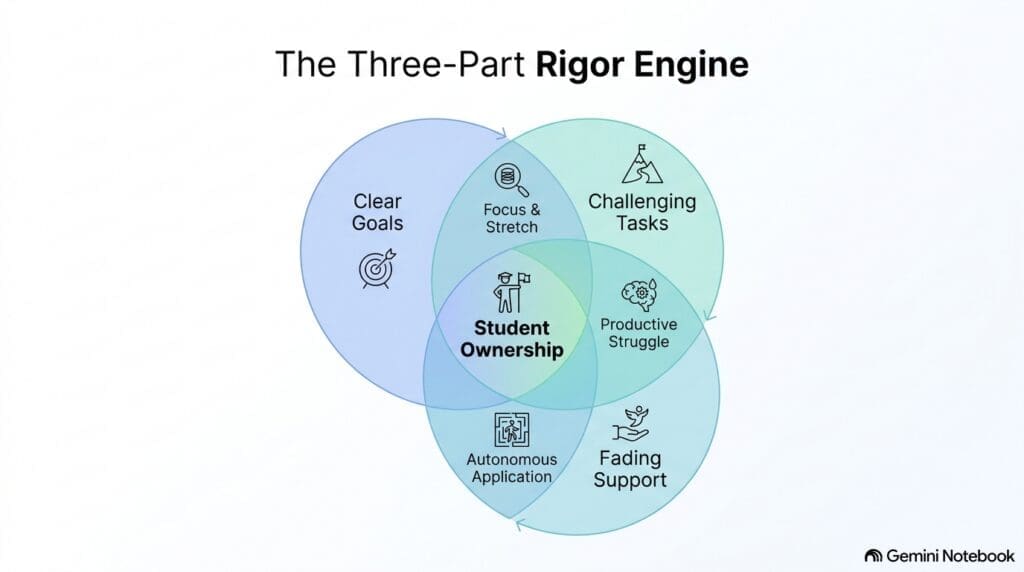
Figure 1: The Three-Part Rigor Engine — Illustrating how Clear Goals, Challenging Tasks, and Fading Support converge to create true Student Ownership.
Link Target Wiring: Visual anchor for Student Ownership & Learner Autonomy.
Rigor as a Ladder, Not a Barrier
The clearest way to picture rigor is a ladder. High expectations set the height. Support is the hand that steadies each rung — and it fades, deliberately, as a student climbs on their own. Rigor isn’t the wall that keeps students out. It’s the ladder they learn to climb without you.
Two tasks on the same text show the difference. Task A asks students to copy vocabulary definitions and answer recall questions. Task B asks them to choose a key idea, find evidence for it, and explain it in their own words. Same text, different rung: Task B demands decision-making, evidence, and original expression. In math, twenty problems using one procedure is the low rung; six problems of rising complexity — followed by comparing two methods and defending the more efficient one — is the higher one.
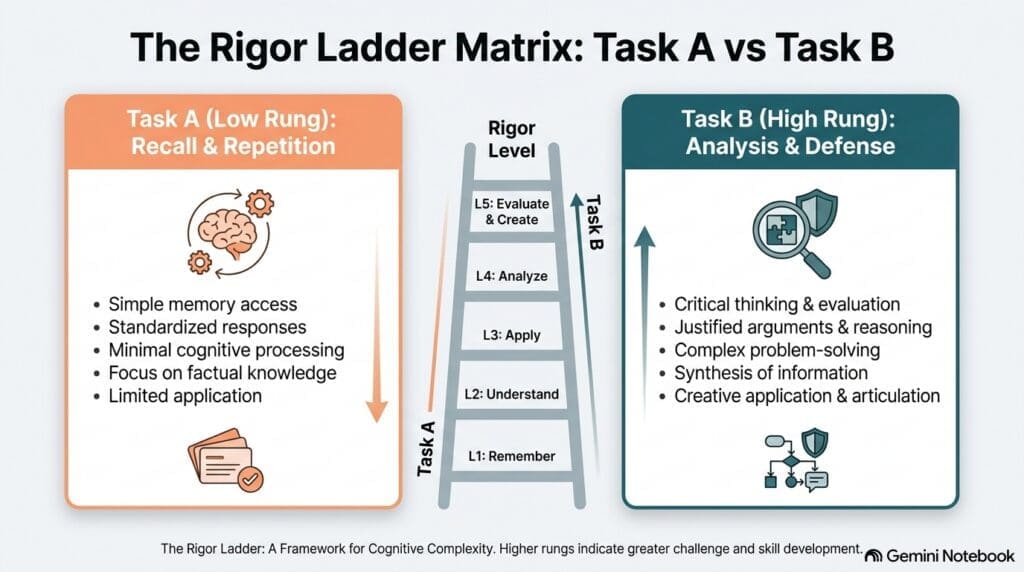
Figure 2: The Rigor Ladder Matrix — Side-by-side comparison of low-rigor recall tasks vs. high-rigor analytical tasks.
The clearest way to picture rigor is a ladder. High expectations set the height. Support is the hand that steadies each rung — and it fades, deliberately, as a student climbs on their own. Rigor isn’t the wall that keeps students out. It’s the ladder they learn to climb without you.
Two tasks on the same text show the difference. Task A asks students to copy vocabulary definitions and answer recall questions. Task B asks them to choose a key idea, find evidence for it, and explain it in their own words. Same text, different rung: Task B demands decision-making, evidence, and original expression. In math, twenty problems using one procedure is the low rung; six problems of rising complexity — followed by comparing two methods and defending the more efficient one — is the higher one.
Figure 2: The Rigor Ladder Matrix — Side-by-side comparison of low-rigor recall tasks vs. high-rigor analytical tasks.
Link Target Wiring: Visual anchor for Task Design & Cognitive Demand.
The Right Level of Challenge
A ladder only works if the next rung is reachable. Too easy and students coast; too hard and they freeze. The right challenge sits in between, at the point where a student can say, “This is hard, but I think I can get it if I try another way.” That’s the point where struggle becomes information instead of a verdict — where an error marks a next step rather than a ceiling.

Figure 3: The Point of Challenge Curve — Mapping student cognitive state against task difficulty to pinpoint the zone of productive struggle.
Link Target Wiring: Visual anchor for The Point of Challenge / Productive Struggle Page.
This is the point of challenge, and finding it is a skill students can learn. Over time they start asking it themselves: “What’s the next step that’s hard enough to help me grow?” That question is the heart of assessment-capable behavior — yes, it’s central, because a student who can locate their own edge of difficulty is already reading their own learning. That reading is what assessment capability is.
What Assessment-Capable Learners Do
Frey, Hattie, and Fisher (2018) describe assessment-capable learners as students who can see their own learning and steer it. In student-friendly terms, they:
Know what success looks like in the current unit Can place their own work on a learning continuum Use feedback, data, and reflection to adjust their approach
In the Visible Learning research, learners who do this with precision show one of the strongest effects on achievement in the base (Frey et al., 2018). And rigor is what makes it possible — because rigor works like a mirror. A challenging task reflects back exactly where a student’s understanding is thin. Simple tasks reflect nothing; there’s no gap to see. The harder, well-designed task is what gives a student something real to read, and reading it is how they grow less dependent on grades and more anchored in standards of their own.

Figure 3: The Point of Challenge Curve — Mapping student cognitive state against task difficulty to pinpoint the zone of productive struggle.
Link Target Wiring: Visual anchor for The Point of Challenge / Productive Struggle Page.
You can hear the difference in how these students talk:
- They know their level: “Right now I can solve one-step equations, but I mix up the steps on two-step problems.”
- They name a goal: “Today I want to focus on checking my answer with inverse operations.”
- They choose a strategy: “For this text, I’ll annotate the margins instead of using sticky notes.”
- They seek feedback: “Can you check whether my evidence matches my claim?” They use mistakes as data: “I lost points on explaining my reasoning, so I’ll add a sentence frame to my notebook.”
- They teach others: “Let me show you how I set this up with the model.”
Every one of those moves depends on a task worth thinking about. Simple work stifles strategic thinking; challenging work makes thinking — and its gaps — visible.
How Rigor, Agency, and Self-Assessment Work Together
It helps to be precise about what a phase and what a force are. Surface, deep, and transfer are the phases of learning — the rungs. Rigor and agency are the forces that move a student up them. They aren’t stops on the ladder; they’re what does the climbing.

Figure 4: The Rigor, Agency, and Self-Assessment Cycle — Continuous loop connecting rigorous tasks, student agency, and self-assessment.
Link Target Wiring: Visual anchor for Self-Assessment & Feedback Systems.
The three run as a cycle. A rigorous task surfaces a student’s strengths and gaps. Agency shows up when the student decides how to respond — a new strategy, a request for feedback. Self-assessment closes the loop: the student measures the work against success criteria, a peer example, or an earlier draft, then plans the next step. Accurate self-judgment feeds back into stronger achievement (Hattie, 2009).
Miss either force, and the cycle stalls. Rigor without agency leaves students feeling pushed and powerless. Agency without rigor leaves them confident but parked at the surface. The two together — demanding work and a learner equipped to answer it — are where the real movement happens.
From Surface to Deep to Transfer
Hattie and Donoghue (2016) describe learning as moving through three phases: surface, deep, and transfer. This is the ladder’s full height — and the top rung is worth naming precisely, because it’s the one most often mislabeled. The third phase is transfer: carrying a skill or understanding into a new, unfamiliar context, where it has to work without the original scaffolding. It isn’t just a change in how a student feels about the material. Rigor lives at every phase; it simply changes shape as students climb.

Figure 5: The Surface–Deep–Transfer Progression — Mapping learning depth from initial retrieval to real-world application.
Link Target Wiring: Visual anchor for Missing Rung: Surface, Deep, & Transfer Series.
Getting surface learning right. Surface learning is the foundation, and it’s not a bad word: it’s where students acquire words, facts, and single-step procedures. What matters is how they engage it. Rigorous surface work goes past copying from the board — short retrieval practice from memory, quick “explain your answer” prompts even on basic items, sorting examples from non-examples. Assessment-capable learners treat these checks as feedback: a yellow mark on a vocabulary quiz becomes a decision to make flashcards and retest in two days. Exit tickets, one-minute writes, and self-rating scales all build the habit — as long as students read them as guidance, not punishment.
Moving into deep learning. Deep learning begins when students connect ideas and ask “Why does this work?” or “How does this relate to what we learned before?” Here rigor comes from cognitive demand, not assignment length. In ELA, students compare two characters’ responses to a challenge, anchor the comparison in quotes, and weigh how setting shapes each one. In science, they design an investigation to isolate a single variable, predict outcomes, and defend the design. Prompts like “Convince a skeptic” or “Find the flaw in this argument” raise the demand. Agency widens too: students choose sources, organizers, and how to show what they know.
Reaching transfer. Transfer is the top rung — the point where a student carries learning into a genuinely new context and it holds. In social studies, students study local housing policy and bring proposals for fair access to the city council. In STEM, they design water filters for homes facing real waterquality problems, judged by lab results and actual impact. The rigor here lives in open-ended problems, authentic audiences, and standards students help set — co-creating rubrics, defining quality, reflecting on product and process. The questions get bigger: “Whose voices are missing from our research?” “How will we know if our solution helped?” This is where ownership is fullest, and where students start to see themselves as people who can act, measure, and improve.
Practical Moves to Start With
None of this requires a curriculum overhaul. Pick one lever, run it for a week or two, and listen to what students say.
Clarify goals and success criteria in student-friendly language. Students can’t self-assess against a goal they can’t read. Rewrite the standard as an “I can” statement:
- Standard: “Analyze how a theme develops over the course of a text.” → “I can explain how a big idea grows from the start of the story to the end.””” Standard: “Solve multi-step real-world problems using proportional relationships.” → “I can break a word problem into steps and use ratios to solve it.”
- Turn those into a checklist students revisit: before — ‘Which parts already feel green?’ During — ‘Which part are you using right now?’; after — ‘Where are you on this goal today, and why?’ The question ‘Where are you now?’ asks for evidence, not a feeling, and daily reps build the skill.
- Use feedback, errors, and reflection to grow agency. Aim feedback at the task and the process, never the person: not “You’re smart” or “You’re wrong,” but “This part meets the goal because…” or “This step is missing, so the answer doesn’t match the problem.” Treat errors as data — “This shows the second step isn’t secure yet; which support would help — a worked example, a peer, a short video?” Then make reflection routine: a quick write (“one strength today… one thing I’ll adjust next time…”), a red-yellow-green selfrating with a reason, or a first-draft/final-draft pair with the changes labeled. Each one keeps the focus on the quality of thinking rather than mere completion.
The Shift Worth Making
Rigor, agency, and the climb from surface to deep to transfer form one coherent path toward assessment-capable learners. When rigor is challenge with support that fades, a classroom becomes demanding and supportive at once. Students learn to read struggle as feedback instead of failure, and to judge their own progress with growing accuracy. The conversation changes from “What grade did I get?” to “What does my work show, and what will I try next?”
That’s the same seventh-grade class, a year later, reaching for the tracking sheet before the test. The next step doesn’t have to be big. Pick one change — clarify a goal, add a reflection routine — and test it with your students. As they take hold of their own progress, the rigor of your tasks starts to feel less like a demand and more like a ladder they’re ready to climb.
References
Frey, N., Hattie, J., & Fisher, D. (2018). Developing assessment-capable visible learners, Grades K–12: Maximizing skill, will, and thrill. Corwin Press.
Hattie, J. (2009). Visible learning: A synthesis of over 800 meta-analyses relating to achievement. Routledge.
Hattie, J. A. C., & Donoghue, G. M. (2016). Learning strategies: A synthesis and conceptual model. npj Science of Learning, 1, 16013. https://doi.org/10.1038/npjscilearn.2016.13
Hattie, J., & Clarke, S. (2018). Visible learning: Feedback. Routledge.