
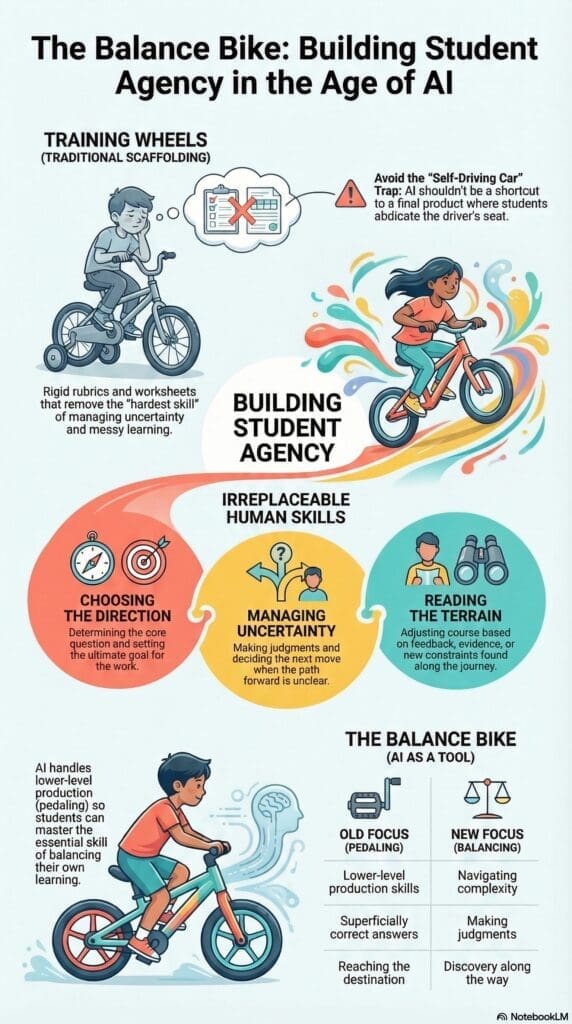
The Training Wheel Dilemma
For years, many children learned to ride a bike with training wheels, which serve as scaffolding that lets them practice steering and pedaling without tipping over. However, these supports also remove the hardest skill from the learning experience: balancing. In our classrooms, many of our instructional supports function exactly like these training wheels. Things like step-by-step worksheets, overly rigid rubrics, and “model” essays might help students reproduce content, but they can unintentionally prevent them from practicing the hardest work, such as managing uncertainty, making judgments, and adjusting their course when things get messy.
The Balance Bike Approach to Learning
Today, many children learn to ride using balance bikes, which feature just a lightweight frame and two wheels, completely ditching the pedals and training wheels. With a balance bike, children coast and simply put their feet down whenever fear bubbles up, meaning that from day one, they are actively scanning, steering, and adjusting. This approach is counterintuitive because it actually helps the learner by taking something away. Instead of adding more support, the balance bike removes the parts that can distract from the central learning objective, forcing learners to tackle the hardest part—embodied balance—first.
Redefining Student Agency in the Age of AI
In a world of artificial intelligence, producing polished text or superficially correct answers is increasingly easy to outsource. Because AI allows students to get much further than they could on their own, educators should elevate their expectations and consider AI as a balance bike. The focus of using AI should shift away from “pedaling”—which represents lower-level production skills—and toward “practicing balance”. This means teaching students how to navigate complexity, make judgments and interpretations, and adjust their course when things get messy.
The 5 Pillars of Irreplaceable Student Work
To use AI wisely, students must take ownership of the cognitive tasks that simply cannot be delegated to a machine. Educators must foster these five irreplaceable skills:
- Choosing a direction: Determining what the question and the ultimate goal are.
- Maintaining effort: Deciding if a problem is worth sticking with when the work gets hard.
- Managing uncertainty: Figuring out what the next move should be when they are not sure.
- Reading the terrain: Recognizing when feedback, evidence, or constraints should change their next move.
- Working with a group: Learning how to listen deeply to collaboratively create a whole that is greater than the sum of its parts.
Keeping Students in the Driver’s Seat
If we only design assignments focused on handing in a final product, AI functions less like a bicycle and more like a self-driving car, tempting students to simply “take a nap in the back”. Educator Maya Bialik once asked a seventh-grade student how they would know when they reached their goal, and the student replied, “When my mom pulls the car over and opens the door for me”. To combat this abdication of responsibility, educators must shift from being providers of information to designers of personalized learning experiences. As author John Steinbeck noted about taking fast interstate highways, we risk traveling “from New York to California without seeing a single thing” if we prioritize speed over the journey. We must design learning experiences that keep students in the driver’s seat, ensuring they don’t just reach a destination, but actually learn and see everything along the way.
Reflection Point 1: The AI Metaphor
Steve Jobs famously called the computer a “bicycle for the mind” because it amplifies our efforts and lets us reach previously unreachable places. But this raises a critical question for today’s classrooms: If the computer is a bicycle, what is AI? Is it a car, a self-driving car, or even a teleportation machine?. Ask yourself: Are the AI tools in your classroom functioning as bicycles that require student effort, or self-driving cars that do all the work?
Reflection Point 2: Staying in the Driver’s Seat
Educator Maya Bialik once challenged her students with goal-setting by asking: “If you don’t know where you’re going, how will you know when you get there?”. One seventh-grader honestly replied, “When my mom pulls the car over and opens the door for me”. Ask yourself: When assignments focus solely on the final product, how do we prevent our students from simply “taking a nap in the back of the self-driving car”?.
Reflection Point 3: The 5 Questions AI Cannot Answer
To ensure students use AI wisely, we must require them to do the cognitive work that simply cannot be delegated to a machine. Are you challenging your students to regularly ask themselves these five questions?
- Choosing a direction: What is the question? The goal?.
- Maintaining effort: Is it worth sticking with when it gets hard?.
- Managing uncertainty: What’s my next move when I am not sure?.
- Reading the terrain: Could feedback, evidence, or constraint change my next move?.
- Working with a group: How do I listen deeply to create a whole that’s greater than the sum of our parts?.
Reference
Bialik, M., & Nilsson, P. (2026, March 11). How to build student agency in a world of AI. Solution Tree Blog.