Visible Learning in Action: How to Document and Value Student Thinking
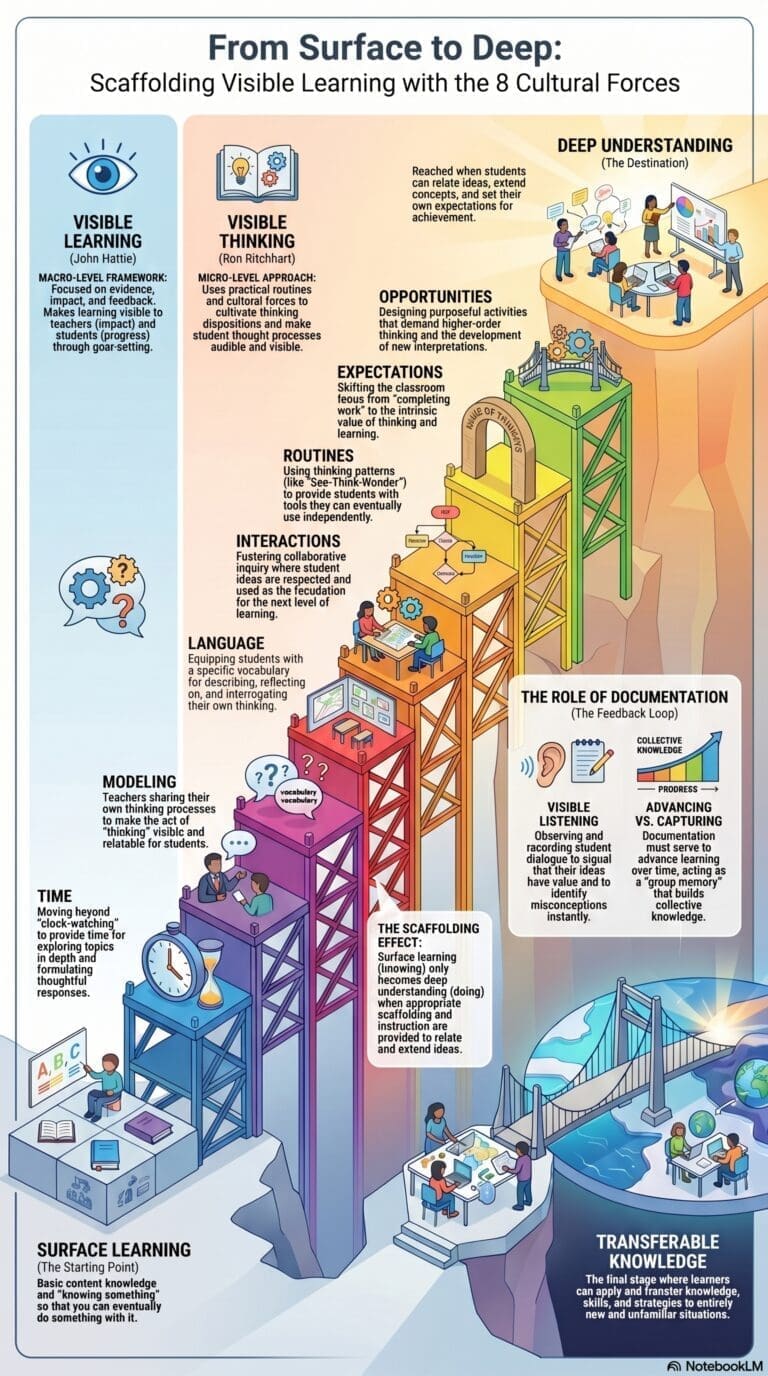
Discover how Learning as a Consequence of Thinking connects to Visible Learning. Practical strategies for teachers to document and value student thinking in the classroom.

Teacher Clarity: Understanding How Learners Learn
Teacher Clarity: Understanding How Learners Learn
Explore innovative student-centered learning frameworks that empower ownership of learning, integrate standards-based practices, foster teacher clarity, ensure academic rigor, and build strong student agency. Find practical strategies and insights to transform classrooms and empower learners for success.
Discover how Learning as a Consequence of Thinking connects to Visible Learning. Practical strategies for teachers to document and value student thinking in the classroom.

Thinking doesn’t get stronger because we tell students to “go deeper.” It gets stronger when we give it shape. Thinking routines are short moves teachers use to help students slow down, notice details, ask better questions, and explain ideas with…

From Student Agency: Building A Culture of Thinking Through Changing Roles, anchor page, I discussed that a Culture of Thinking means the eight forces that shape classroom life: expectations, language, time, modeling, routines, interactions, opportunities, and environment (Project Zero, 2024).…

A driving question gives a project-based learning unit its purpose and direction. This post covers what PBL driving questions are, how to write them using a simple formula, and how to use them throughout a project. Without a strong driving…

Rigor gets misread all the time. It isn’t a heavier backpack, a stricter gradebook, or a lesson pushed at top speed. In school, rigor means students think carefully, explain their ideas, apply learning in new situations, and keep working through…
Student Ownership and Learner Autonomy Student Ownership and Learner Autonomy mean students have a real hand in how they learn, track progress, and respond to challenge. They do more than follow directions. They understand the goal, make choices within it,…
Introduction Self-efficacy is a student’s belief that they can succeed at a task. That belief shapes whether they start, how long they stick with it, and what they do when learning gets hard. For educators, the goal isn’t to choose…
Introduction Molly Ness, an author and former teacher, struggles to engage her students in the classroom. Ness often had to compete for students’ attention with technology and distractions such as Pokémon cards and fidget spinners. Ness constantly stays on top…
From Implicit to Explicit: Schema and Success Criteria Teachers often know exactly what they want students to learn. The problem is that students don’t always see the map. They may hear the task, start the work, and still miss what…
Ms. Rivera collects lab notebooks and sees the same pattern again. The conclusion sections look “finished,” but the reasoning is thin. When she writes feedback, students skim it, then move on. The next lab looks the same. So she tries…
Introduction Many classrooms appear active, but genuine thinking is absent. Students may complete tasks, yet their attention is elsewhere. This disconnect between activity and thought leads to missed learning opportunities. Student engagement is not about noise or compliant behavior. It…
Introduction Imagine your students clearly stating what they are learning, how they will demonstrate it, and their next steps if they encounter challenges. This is the impact of clear learning targets, success criteria, evidence of learning, actionable feedback, and student…
Introduction What leads students to ask their own questions in class? In Beautiful Questions in the Classroom, Warren Berger describes a two-part approach he calls the Provoke and Release Strategy. This method uses curiosity as the starting point and gives students space…
What is Productive Struggle? Productive struggle involves developing habits of mind, such as perseverance and flexible thinking, rather than just seeking instant solutions. You should expect not to know how to solve a problem at first. The goal is to…
What is SCRUM? Why I Scrum: Using a Project Management Tool for PBL SCRUM tools support Scrum ceremonies, including planning sprints, keeping track of daily work, refining backlogs, and using data from the past to keep improving. When people work…
What is Unconscious Bias? Unconscious bias is also called implicit bias—a type of social cognition that occurs below the surface, making it harder to detect as defined by Huda Essa, author of the book The Consciously Unbiased Educator. Essa cites…