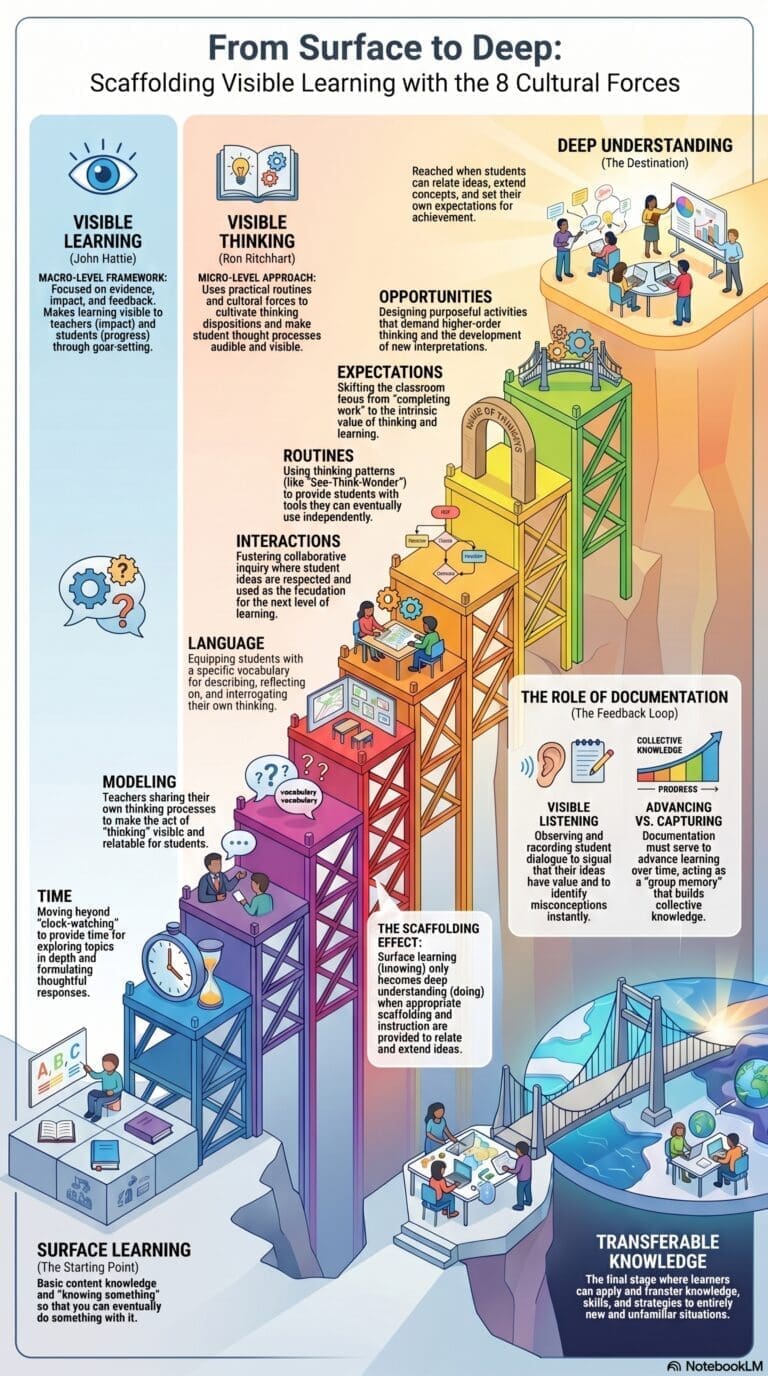
A driving question gives a project-based learning unit its purpose and direction. This post covers what PBL driving questions are, how to write them using a simple formula, and how to use them throughout a project. Without a strong driving question, a project can feel like a string of activities with a poster at the end.
That is why educators should care. A strong driving question is open-ended, connected to a real issue or audience, and clear enough to guide instruction day by day. When it works, students stop asking, “Why are we doing this?” The question has already answered it.
What driving questions in PBL really do for learning
In PBL, the driving question is not a warm-up, an exit ticket, or a textbook prompt in disguise. It is the center of the unit. It gives inquiry a direction and gives content, skills, and products a shared purpose.
Why a driving question gives the project a clear purpose
Students can tell when a project is a wrapper around ordinary work. They can also tell when the work is headed somewhere real. A good driving question closes that gap.
As Teacher Magazine explains in its guidance on creating effective driving questions, the question gives learning a meaningful context and keeps inquiry cohesive (Teacher Magazine, n.d.). That point matters in planning. If the question is clear, then mini-lessons, research tasks, discussions, and final products all answer the same need.
Think of it like a spine. Without it, the project bends in too many directions. With it, students can see how a reading assignment, a lab, or a writing draft fits the bigger effort.
What makes a question strong instead of shallow
A strong driving question has a few plain traits. It is open-ended. It is interesting enough to sustain work for days or weeks. It points toward required standards without reading like a standard. It also connects to a real issue, audience, decision, or challenge.
Common stems help. “How can we…” and “Why does…” often lead to better inquiry than “What is…” or “List the reasons…” The answer should not sit on the first page of a search result.
PBLWorks’ article on writing a driving question puts it simply: the question should be understandable, engaging, open-ended, and aligned to learning goals (Larmer & Larmer, 2018).
If students can answer the question in one quick search, it probably isn’t the question that should drive the project.
A shallow version asks for recall. A strong version asks students to investigate, weigh options, and explain their thinking.
How to write a driving question that students can actually investigate
Writing a good question is part design, part revision. Most first drafts are either too broad or too thin. That is normal.

Start with standards, skills, and the real-world connection
Start with the learning, not the slogan. What content must students learn? What thinking do they need to do? Are they analyzing sources, modeling data, designing a product, making an argument?
Once those goals are clear, connect them to a real issue or useful context. That could be a local water concern, a school policy, a neighborhood design problem, or a public audience. The question gets better when students can picture who it matters to.
Performing in Education’s guide to driving questions is useful here because it separates directed classroom questions from the one open-ended question that carries the project (Smith). That distinction keeps us from mistaking a lesson objective for a project question.
Use a simple formula to turn a topic into a driving question
A practical formula helps: how or why + action or problem + audience or need + context.
That sounds abstract, so here are quick examples:
- Science: How can we reduce stormwater runoff around our school?
- ELA: How can we create a podcast that helps our community understand a local issue?
- Social studies: Why do people disagree about who should make public decisions in a democracy?
- Math: How can we use data to reduce cafeteria food waste?
The formula is not the point. It is training wheels. It helps move a topic like “weather,” “fractions,” or “the Constitution” into a question students can investigate and answer with evidence.
Test the question before you launch the project
Before the project starts, pressure-test the question. A short checklist usually catches weak spots:
- Is it open-ended?
- Is it worth answering?
- Can students make progress within the project timeline?
- Does it require the standards we need to teach?
- Will students understand what the question is asking?
Edutopia’s piece on refining driving questions warns against the usual problems: questions that are too broad, too narrow, too teacher-directed, or too close to a textbook prompt (Miller, 2011). If a question sounds like a chapter review, rewrite it. If it could lead anywhere and nowhere, narrow it.
How to implement driving questions in real PBL classrooms
A good question can still fail in use. Implementation is where many projects drift. The fix is simple, but it takes discipline: keep the question alive from launch to presentation.

Introduce the question in a way that sparks curiosity
Reading the question off a slide is rarely enough. Students need a reason to care. That reason can come from a community problem, a case study, a guest speaker, a surprising text, a live event, or a design challenge.
The launch should make the question feel urgent, or at least interesting. If the unit asks, “How can we improve water use at school?” then show students real waste data. If the unit asks, “How should a community remember hard history?” begin with conflicting memorial examples. Curiosity grows when the question feels attached to something concrete.
Keep the driving question active from start to finish
The question should show up all through the project, not only on day one. Revisit it during mini-lessons. Put it in student notebooks. Use it to frame checkpoints, peer feedback, and revision.
Defined Learning’s explanation of essential and driving questions in PBL is helpful here because it treats the question as a focusing tool, not a decorative opening line(Larmer, 2026). Daily work should keep pushing toward an answer.
A quick classroom move works well: ask students, at the end of a lesson, “How did today’s work help us answer the driving question?” If they can’t say, the lesson may need a tighter link.
Let students help shape the question when it makes sense
A clear 2026 pattern in PBL practice is co-creation. Teachers still set the guardrails, but students often help refine the wording, angle, or audience. That small shift can raise ownership fast.
This does not mean handing over the whole design. It means inviting students to help make the question clearer, more relevant, or more local. A class might turn “How can we reduce waste?” into “How can we reduce lunchtime plastic waste in our school?” Same standards, stronger buy-in.
Resources on co-creating a driving question show simple protocols for this kind of refinement (2024). The teacher still protects focus and alignment. Students help make the question worth pursuing.
Common mistakes, strong examples, and small improvements that matter
Most weak PBL units do not fail because the idea is bad. They fail because the question is fuzzy, forced, or disconnected from the real work.
Mistakes that weaken inquiry before the project even starts
The first mistake is going too broad. “How does the world work?” is not a project question. It is a philosophy seminar. The second mistake is going too small. “What are the parts of a plant cell?” cannot sustain inquiry for long.
Another common problem is the fake role. Older students often reject thin scenarios like “Pretend you are an ancient ruler” unless the role leads to real analysis or production. Questions also break down when they ignore age level, time, or standards. A strong question should stretch students, not bury them.
Small edits help. Replace vague words with a context. Replace “learn about” with “improve,” “design,” “explain,” or “recommend.” Replace a generic audience with a real one.
Examples of effective driving questions across subjects
A few short examples make the pattern easier to see.
| Subject | Driving question | Why it works |
|---|---|---|
| ELA | How can we use storytelling to help our community understand a local issue? | It asks for research, audience awareness, and real communication. |
| Science | How can we reduce the urban heat effect around our school? | It connects content to a visible local problem. |
| Social studies | Why do communities disagree about how history should be remembered? | It invites evidence, perspective, and debate. |
| Math | How can we use school data to cut cafeteria food waste? | It gives math a clear purpose and real numbers to analyze. |
The best examples feel age-appropriate and grounded. They do not ask students to solve everything. They ask them to investigate something that matters and produce an answer that uses the required learning.
Conclusion
Driving questions are the heart of PBL, but they are also a practical design tool. When the question is meaningful, open-ended, and tied to real learning goals, the project holds together. Students know what they are working toward, and teachers have a clearer line for planning.
If one current unit feels scattered, start there. Revise the question first, test it against the checklist, and keep it visible through the whole project. A better driving question does not fix everything, but it often fixes the part that matters most: purpose.
Reference
Sood, D., & Kapoor, A. (2025, May 29). Creating effective driving questions in project-based learning -… Teacher Magazine. https://www.teachermagazine.com/in_en/articles/creating-effective-driving-questions-in-project-based-learning
Larmer, J., & Larmer, J. (2018, July 13). A tricky part of PBL: Writing a driving question. PBLWorks. https://www.pblworks.org/blog/tricky-part-pbl-writing-driving-question
Smith, A. (n.d.). Driving Questions in Project-Based Learning. Performing in Education. https://performingineducation.com/driving-questions/
Miller, A. (2011, August 24). How to refine driving questions for effective project-based learning. Edutopia. https://www.edutopia.org/blog/pbl-how-to-refine-driving-questions-andrew-miller?page=3
Larmer, J. (2026, February 26). PBL Pro tip: How are essential questions and driving questions used in PBL?. Defined. https://blog.definedlearning.com/pbl-pro-tip-how-are-essential-questions-and-driving-questions-used-in-pbl/
PBL: Driving question. The Consortium for Public Education. (2024, December 19). https://www.theconsortiumforpubliceducation.org/resource/project-based-learning-resources-pbl/driving-question/