
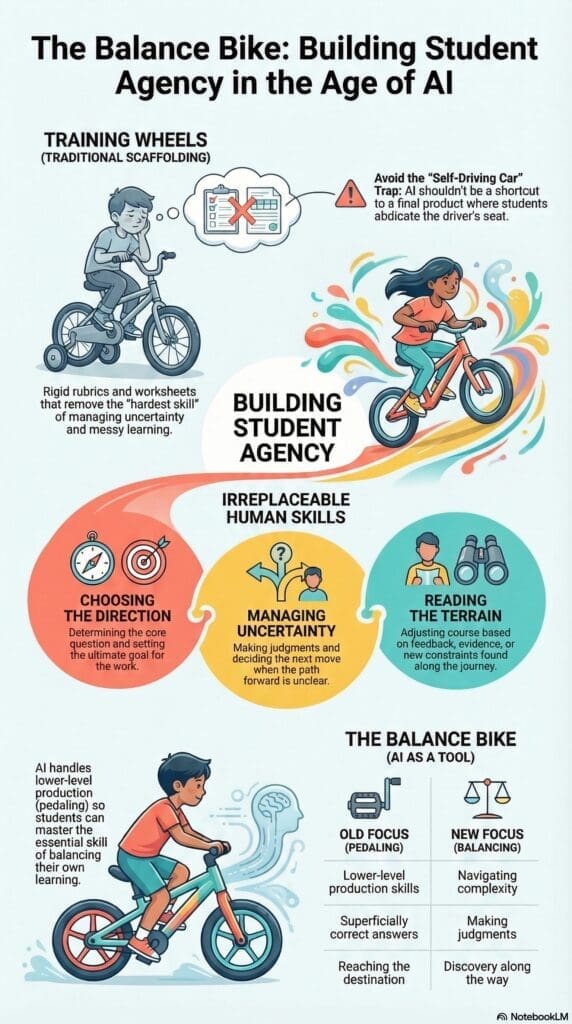
The Scaffolding Metaphor: Training Wheels vs. Balance Bikes
For generations, the standard approach to bicycle instruction involved training wheels. As a form of pedagogical scaffolding, training wheels allow a child to practice the mechanics of steering and pedaling while being protected from tipping over. However, this method fundamentally removes the “hardest skill” from the learning experience: balancing.
In contrast, the “balance bike” model—a lightweight frame without pedals or training wheels—requires the learner to embody the skill of balancing from day one. On a balance bike, children are constantly scanning, steering, and adjusting. Crucially, it provides psychological safety; students can “put their feet down whenever fear bubbles up.” By the time pedals are eventually introduced, the most difficult part of the process has already become embodied knowledge. As we navigate the complexities of artificial intelligence (AI), this shift in mindset, prioritizing the core challenge of “balance” over the mechanical output of “pedaling,” is essential for fostering true student agency.
The Pitfall of Educational “Training Wheels”
In the traditional classroom, many of our standard supports function like training wheels. While intended to guide, they often become crutches that allow students to reproduce more than they understand. These supports include:
- Step-by-step worksheets that dictate every move.
- Overly rigid rubrics that prioritize compliance over creativity.
- “Model” essays that students mimic without internalizing the
- underlying logic.
The danger of these “training wheels” is that they unintentionally prevent students from practicing the only work that will remain relevant in an increasingly automated world. To build agency, we must strip away the distractions and force engagement with the hardest work:
- Managing uncertainty
- Making judgments
- Adjusting course when things get messy
AI Literacy and the “Balance Bike” Model
AI literacy presents a unique challenge because the tool makes it incredibly easy to outsource “pedaling”—the production of polished text or superficially correct answers. If we view AI merely as an efficiency tool, we risk turning education into a passive experience.
To design effective learning in the AI era, we must treat the technology as a balance bike. This requires a fundamental shift in instructional focus: we must move from “pedaling” (lower-level production skills) to “balancing” (navigating complexity, making interpretations, and managing messy variables). When AI is integrated, educators should use the opportunity to elevate expectations. Because a student on a “bike” (AI) can travel much further and faster than they could on foot, the complexity of the destination must increase accordingly. Conversely, we must also identify the moments when a learning objective is so fundamental to “balance” that it requires not using AI at all.
The Irreplaceable Human Skills
To use AI wisely, students must master the work that cannot be delegated to an algorithm. In their work on AI and pedagogy, Peter Nilsson and Maya Bialik identify five irreplaceable skills that students must exercise to stay in the driver’s seat. These are the essential questions of the human learner:
- Choosing a direction: What is the question? The goal?
- Maintaining effort: Is it worth sticking with when it gets hard?
- Managing uncertainty: What’s my next move when I am not sure?
- Reading the terrain: Could feedback, evidence, or constraint change my next move?
- Working with a group: How do I listen deeply to create a whole that’s greater than the sum of our parts?
The Journey vs. The Destination: Technology Analogies
The history of technology is often framed as a quest for efficiency, but in education, efficiency can be the enemy of insight.
- Bicycles vs. Self-Driving Cars: Steve Jobs famously called the computer a “bicycle for the mind,” a tool that makes human effort go further. However, AI often functions more like a “self-driving car.” For students who believe the sole purpose of an assignment is the final product, it is tempting to “take a nap” in the back seat. Maya Bialik illustrates this through a 7th-grade student who, when asked how she would know if she reached her goal, replied: “When my mom pulls the car over and opens the door for me.”
- Interstates vs. Small Roads: In Travels with Charley, John Steinbeck reflected on the rise of interstate highways. While faster, they lacked the character of the small roads. He warned that on these thruways, “we can drive from New York to California without seeing a single thing.”
- The Risk of High-Speed Commuting: This is the great risk of instructional technology. If we focus exclusively on the final product, we turn education into a “high-speed commute” to a destination. We may reach the end of the semester without “seeing a single thing” along the way.
The Evolving Role of the Educator
In the era of AI, our role is undergoing a necessary transformation. We are shifting from “providers of information” to “designers of personalized learning experiences.” Our primary mission is no longer to help students generate answers, but to protect the journey of the learner.
As Peter Nilsson and Maya Bialik argue in their book, Irreplaceable: How AI Changes Everything, the future of teaching is not about the newest app or the fastest “thruway” to a result. It is about the ethics of AI use and the commitment to building student agency through every lesson. We must guide students through the “hardest work” of being human—managing the messiness of uncertainty and making informed judgments. As we redesign our practices, let’s ensure our students don’t just reach the destination—let’s make sure they see everything along the way.
Reflection Points throughout your Student Agency
Reflection Point 1: The AI Metaphor
Steve Jobs famously called the computer a “bicycle for the mind” because it amplifies our efforts and lets us reach previously unreachable places. But this raises a critical question for today’s classrooms: If the computer is a bicycle, what is AI? Is it a car, a self-driving car, or even a teleportation machine?
Ask yourself: Are the AI tools in your classroom functioning as bicycles that require student effort, or self-driving cars that do all the work?
Reflection Point 2: Staying in the Driver’s Seat
Educator Maya Bialik once challenged her students with goal-setting by asking: If you don’t know where you’re going, how will you know when you get there? One seventh-grader honestly replied, “When my mom pulls the car over and opens the door for me.”
Ask yourself: When assignments focus solely on the final product, how do we prevent our students from simply “taking a nap in the back of the self-driving car?
Reflection Point 3: The 5 Questions AI Cannot Answer
To ensure students use AI wisely, we must require them to do the cognitive work that simply cannot be delegated to a machine. Are you challenging your students to ask themselves these five questions regularly?
Choosing a direction: What is the question? The goal?
Maintaining effort: Is it worth sticking with when it gets hard?
Managing uncertainty: What’s my next move when I am not sure?
Reading the terrain: Could feedback, evidence, or constraint change my next move?
Working with a group: How do I listen deeply to create a whole that’s greater than the sum of our parts?
Reference
Bialik, M., & Nilsson, P. (2026, March 11). How to build student agency in a world of AI. Solution Tree Blog.