


Source: Compass-Pd.Com
Introduction: The Lost Hiker Analogy
When educator and instructional coach Tyler Rablin (2024) first began teaching, he faced a challenge familiar to
many classroom teachers: reacting to individual student struggles as they occurred and trying to put out academic
fires one by one. Rablin recognized that if students were going to take true ownership of their education, they neede more than just a list of standards or a final score on a rubric at the end of a unit. They needed a map.
Rablin (2024) compares a learning progression to a hiker’s map. When hikers head out into the wilderness, they do
not rely solely on a guide to tell them where to place each foot—they consult a map to see where they are currently
located, where they are heading, and how to course-correct if they stray off path. For too long, standards and
assessment frameworks have remained tucked away in teacher plan books. Sharing learning progressions directly
with students transforms standards from an internal grading instrument into a dynamic roadmap for student
self-direction.
The Paradigm Shift: Assessment as an Ongoing Journey
In traditional educational settings, assessment is frequently treated as a noun—an isolated endpoint or final exam
that happens to students. However, as assessment experts Hillman and Stalets (2022) emphasize alongside Erkens
et al. (2017), effective assessment must be re-envisioned as an ongoing, fluid process—a verb.
Hillman and Stalets (2022) define a learning progression as a series of clear achievement targets broken down from a
priority standard and ordered sequentially from simplest to most complex. When made fully transparent, this
sequence shifts the classroom dynamic from teacher-led evaluation to student-centered self-awareness. Students no
longer have to guess what ‘good work’ looks like or why they received a specific mark; the criteria and actionable next steps are visible from day one.
Mapping the Territory: The 4 Stages of Progression
To make complex standards accessible to learners, Hillman and Stalets (2022) adopt Katie White’s (2017) four-stage
continuum from Softening the Edges. This continuum provides a structured pathway that honors where every student
enters the learning process:
- Readiness-Building Targets: These targets focus on prerequisite foundational knowledge, vocabulary, and
concepts. They allow students with prior gaps to identify exactly what they need to get up to speed before tackling grade-level work (White, 2017).
- Exploration Targets: Addressing daily instruction and scaffolding at a lower Depth of Knowledge (DOK) level
than the target standard requires (Webb, 2002), these targets build confidence and establish solid conceptual foundations.
- Proficiency Targets: These targets outline the precise underpinning steps needed to master the core priority
standard. They guide daily formative feedback and recombine on summative evaluations to confirm learning (Hillman & Stalets, 2022).
4. Targets for Enriched Understanding: Designed for differentiation, these targets answer the question, ‘What if students have already mastered the standard?’ They encourage learners to push beyond baseline expectations through complex, interconnected applications.
Climbing the Ladder: Transparent Levels & Anchor Words
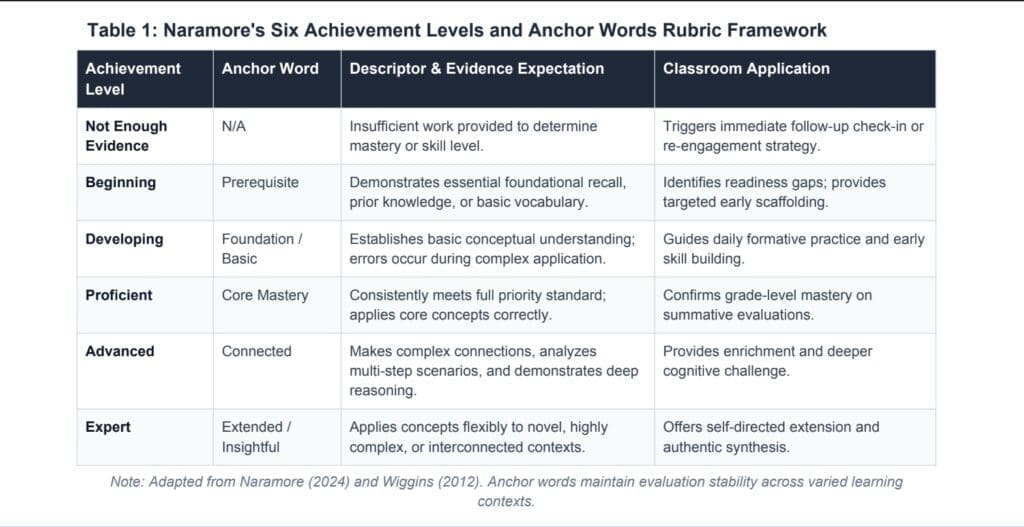
To help students gauge their current location along these stages, Elise Naramore (2024) offers the Ladder Analogy.
Each performance level functions like a rung on a ladder: a learner must stand firmly on one rung before safely
advancing to the next (e.g., reaching ‘Beginning’ before progressing to ‘Developing’).
Crucially, Naramore (2024) notes that unlike a physical ladder, the rungs of a learning progression are unevenly
spaced. Students often move rapidly through introductory readiness skills to a ‘Developing’ stage, but reaching
‘Proficient’ and ‘Advanced’ mastery requires significantly more instructional time, deliberate practice, and cognitive depth.
To keep feedback trustworthy and consistent over time, Naramore (2024) incorporates Anchor Words across
achievement levels. Citing Grant Wiggins (2012), Naramore emphasizes that performers can only adjust successfully
when information is stable and accurate. Anchor words establish a shared understanding between teachers and
students regarding what work at each level represents.
Bringing Progressions to Life in the Classroom
A learning progression fosters true learner agency only when students actively engage with it. Printing progressions and using them directly as daily learning targets create instructional cohesion while saving teachers from rewriting goals every morning (Rablin, 2024).
Practical strategies for putting progressions into action include:
- Make Progressions Visible: Post progressions in the learning space, include them as headers on assignments, or
utilize them as unit pre-assessments (Hillman & Stalets, 2022). - Pair with Reflection Tools: Provide a simple reflection tracker alongside the progression. As students complete
daily tasks, they self-assess and log targets met, shifting their mindset from ‘completing tasks’ to ‘tracking growth’ (Hillman & Stalets, 2022). - Scaffold Independence: Younger learners benefit from explicit modeling and guided practice, while older students
thrive with consistent prompts to use progressions for self-correction.
Conclusion: From Compliance to Independence
When we demystify standards through transparent learning progressions, we move beyond teacher clarity into true
learner agency (Mullen, 2026; Rablin, 2024). By providing a clear roadmap, visible ladder rungs, and ongoing
self-reflection routines, we equip every student with an accessible starting floor and an unlimited ceiling for personal growth.
References
Erkens, C., Schimmer, T., & Dimich, N. (2017). Essential assessment: Six tenets for bringing hope, efficacy, and achievement to the classroom. Solution Tree Press.
Hillman, G., & Stalets, M. (2022). Assessment as a catalyst for learning: Creating a responsive and fluid process to inspire all students. Solution Tree Press.
Mullen, G. (2026, April 19). Re: Demystifying standards with learning progression [Comment]. Maria’s Substack.
https://marialee383.substack.com/p/demystifying-standards-with-learning
Naramore, E. (2024). The Learning Progression Model: Transforming assessment to support student success. Reimagined
Schools.
Needleman, S. (2026, February 27). Moving from standards to learning targets. JumpRope.
https://jumpro.pe/moving-from-standards-to-learning-targets/
Rablin, T. (2024, October 7). The power of learning progressions. Edutopia.
https://www.edutopia.org/article/learning-progressions-differentiation
Webb, N. L. (2002). Depth-of-knowledge levels for four content areas. Wisconsin Center for Education Research.
White, K. (2017). Softening the edges: Deconstruct, align, and transform the assessment process. Solution Tree Press.
Wiggins, G. (2012). Seven keys to effective feedback. Educational Leadership, 70(1), 10–16.
