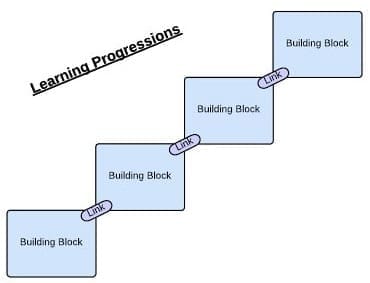
Introduction: The Power of Teacher Clarity
We’ve all felt that Sunday-night weight – the pressure of starting at a massive, multi-page state standard and trying to turn it into a Tuesday morning lesson that doesn’t just keep students busy, but actually moves the needle on their thinking. Picture this scenario: Students perfectly complete a worksheet (Compliance) while completely missing the historical weight or scientific logic of the task (cognition). This is the central challenge of Teacher clarity – the single most powerful tool in our instructional arsenal.
According to John Hattie’s Visible Learning: The Sequel (2024), teacher clarity carries an extraordinary effect size of 0.75 to 0.85. In the classroom, that translates to the potential for two years of student academic growth in a single school year. To unlock this, we must solve the’Compliance vs Cognition’ problem. Let’s move past task-based targets like “finish the T-chart” and toward cognitive clarity using the formula: ‘I can [Cognitive Verb]by strategy/context.’ To bridge this gap, we bring in the CARE Framework (Clarity, Articulate, Refine, Execute) – developed by Matt Hudson who is a 11 years veteran teacher and taught in Indonesia for a while before coming back to United States – to help us design lessons that work.
Think of CARE as a ‘design studio’ approach that prevents planning from becoming a ‘paperwork endurance event.’ It lets us slow down, ensure students own the hardest thinking, and navigate the new world of technology with a steady hand. Remember: AI Reacts, You Judge.
The Alignment Spectrum: Foundations to Daily Evidence
Instructional design fails when we confuse year-end benchmarks with daily classroom action. By using what I call the “Clarity Compass,” we can distinguish between the high-level foundations (the “what”) and the daily evidence (the “how”).
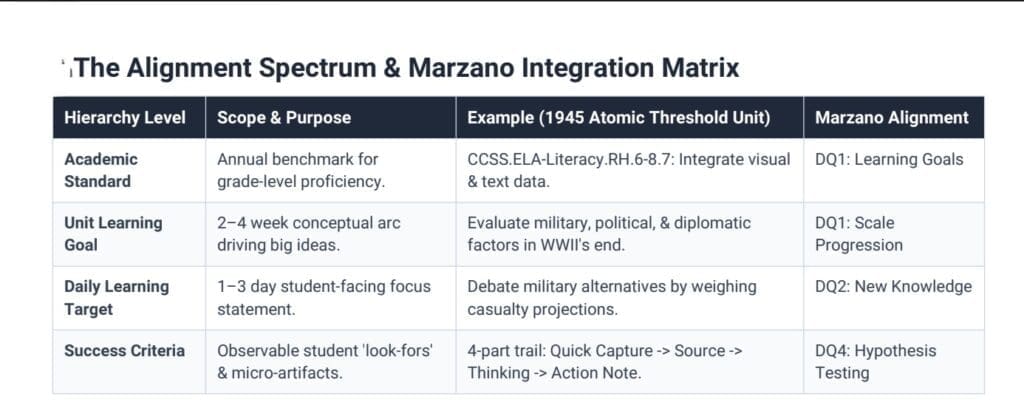
Source: Table design by Gemini Notebook
The CARE Lesson Re-Design Framework

Source: Learning to Learn Well The CARE AI-Ready Classroom Starter Kit By Matt Hudson
Graphic: Gemini Notebook
It is a structured pedagogical design process that helps educators redesign lessons to make student thinking visible, intentional, and student-owned. Designed to operate effectively in an AI-rich environment, CARE provides a structured way to “slow down” and make deliberate design choices so that AI supports learning without replacing the core thinking students must do for themselves.
The framework operates on two parallel levels:
Teacher Design: The process teachers use to clarify, draft, refine, and prepare a lesson.
Student Learning: The pathway students follow as they move their developing understanding through the lesson
The Four Stages of CARE
CARE is an acronym for the four core stages of the redesign process:
C – Clarify
Teacher Design: The teacher builds a design brief covering lesson context, accommodations, and AI guidelines, then explicitly defines the student-owned thinking—the exact decision, interpretation, or judgment students must make independently.
Student Experience: Students encounter the core idea or topic, notice key details, ask initial questions, and record a first reaction or observation before any outside explanation.
A – Articulate
Teacher Design: The teacher turns intent into a complete learning pathway, laying out what students will think and do at each step. The initial draft is reviewed and annotated for ownership gaps or excessive process before editing.
Students Experience: Students select an idea or claim and explain it using their own personal language rather than relying on source text or AI phrasing.
R – Refine
Teacher Design: The teacher evaluates the lesson structure, applies targeted thinking lenses (e.g., Socratic questioning, error analysis, or problem framing), and uses peer feedback or targeted AI prompts to solve specific design issues. The teacher maintains final authority over pedagogical decisions (“AI reacts. You judge.”)
Student Experience: Students test, challenge, connect, or revise their initial claims in response to peer feedback, counterarguments, or new evidence.
E – Execute
Teacher Design: The teacher launches the redesigned lesson in the classroom (or runs a pilot/rehearsal if students are unavailable) to gather evidence on student thinking and engagement.
Student Experience: Students create, apply, perform, test, or decide on a final task or output based on their developed understanding.
Key Principles of CARE
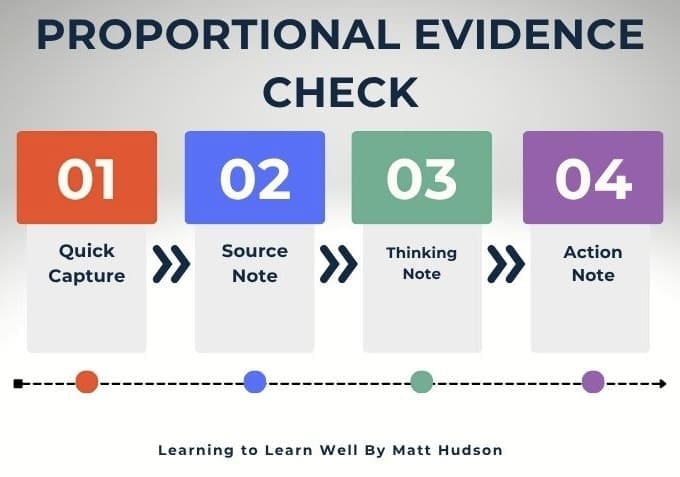
Proportional Evidence (The Learning Trail): Rather than turning lessons into heavy paperwork, CARE advocates collecting small, meaningful artifacts at each stage (e.g., a Quick Capture, Source Note, Thinking Note, and Action Note)
Clear AI Boundaries: AI can assist with drafting, comparing, or prompting during design, but its role is strictly bounded downstream so students retain responsibility for critical thinking.
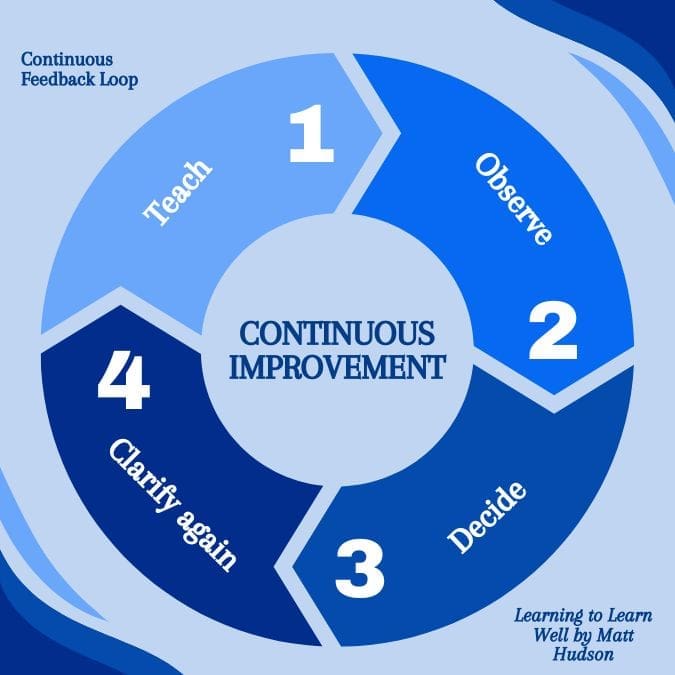
Continuous Feedback Loop: Classroom evidence drives future redesigns through a four-part cycle: See Diagram Below
Case Study: Day 8 Redesign (3-Day / 1-Week Mini-Unit Arc)
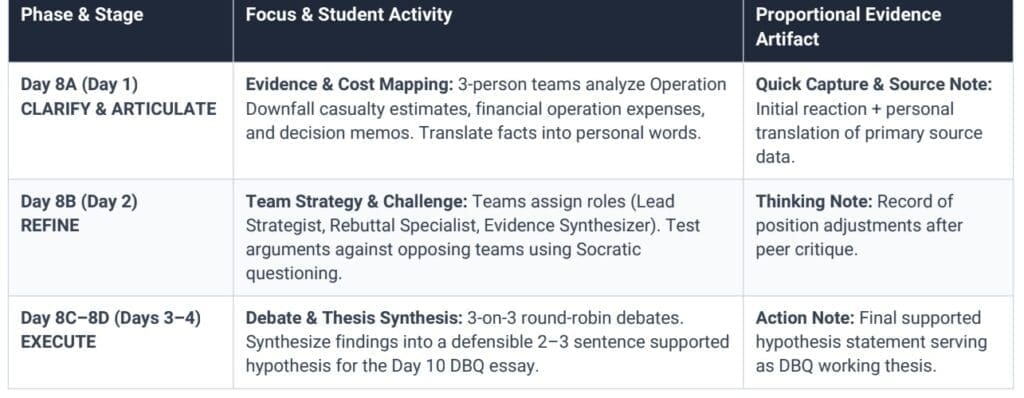
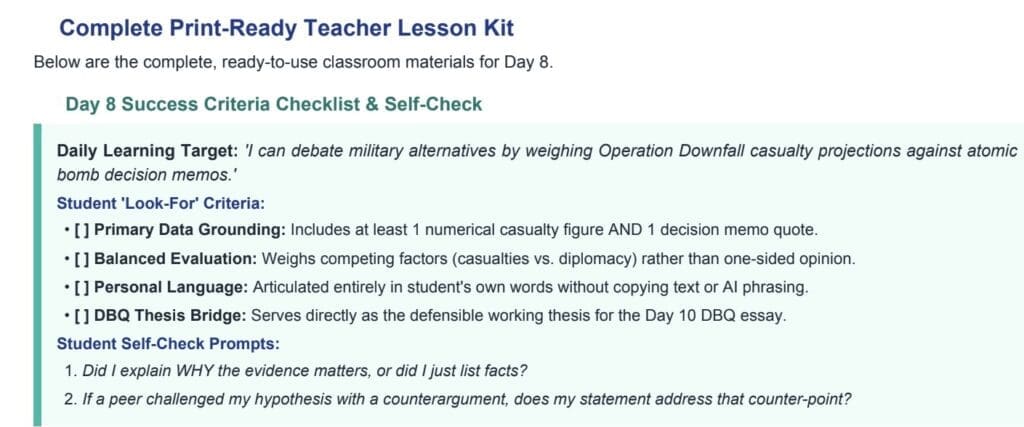
High-level cognitive tasks—such as evaluating military operation expenses, human casualty projections, and strategic decision memos—cannot be crammed into a single 45-minute period without reducing learning to surface compliance. In collaboration with Matt Hudson’s CARE design principles, Day 8 of the 1945: The Atomic Threshold unit expands into a 3-Day to 1-Week Mini-Unit Arc with 3-person student teams:
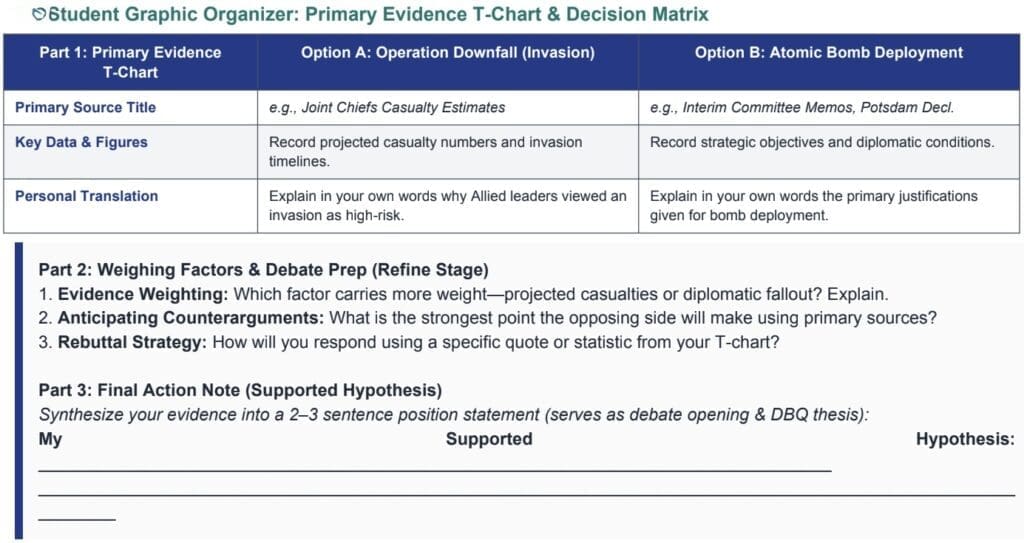
Printable Student Handout: Primary Evidence T-Chart & Decision Matrix
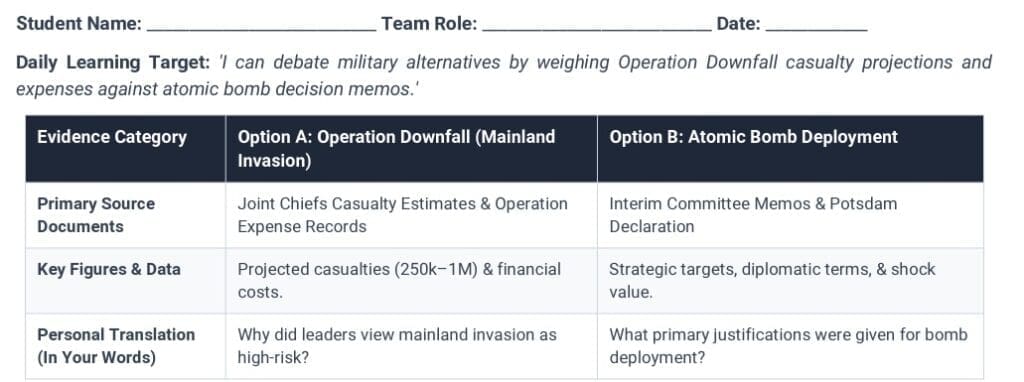
Day 8: Evaluating Decision Factors (Operation Downfall vs. Atomic Bomb)from the Learning Goals, Standards & Targets unit redesigned through the CARE Lesson Re-Design Framework
C – Clarify (The Design Brief & Target)
Lesson Context: Day 8 of the 15-day US History unit on the 1945 Atomic Threshold (Week 2: The Decision to Drop the Bomb).
Original Specs: Learning Target: “I can debate military alternatives by weighing Operation Downfall casualty projections against atomic bomb decision memos.”
Original Task: Construct a T-chart categorizing arguments for and against invasion using primary decision memos and invasion casualty estimates.
Student-Owned Thinking: Students must move beyond merely categorizing text into a table; they must evaluate military necessity by deciding which factors (casualty estimates vs. political risks vs. strategic outcomes) carry the most weight.
Locked Design Target: “I am designing a lesson in which students will evaluate military alternatives to the atomic bomb.” They must determine which primary evidence carries the most weight in justifying or questioning military necessity. The final learning should become a supported hypothesis regarding Allied strategy.
A – Articulate (The Student Learning Pathway)
Rather than giving students a blank T-chart to fill out passively, the student experience is structured into four visible thinking moves:
Student Clarify (First Encounter):
Activity: Students view an uncontextualized primary chart of Operation Downfall casualty projections alongside an excerpt from a 1945 Allied decision memo before teacher explanation.
Learning Trail: Quick Capture — Students write a 1-sentence initial observation or question about the projected human cost of invasion vs. deployment.
Student Articulate (Personal Explanation):
Activity: Students select at least two military and two political arguments from the documents. They construct their T-chart, translating primary arguments into their own words rather than copying the source text.
Learning Trail: Source Note — A brief summary in personal language explaining why Allied commanders viewed invasion as high-risk.
Student Refine (Testing & Revision):
Activity: Students pair up to swap T-charts and apply a Counterargument Lens. Each student must challenge their partner’s strongest argument with a counterpoint from the primary texts (e.g., questioning casualty estimates or political fallout).
Learning Trail: Thinking Note — A record of how the student adjusted or defended their position after facing peer critique.
Student Execute (Action & Synthesis):
Activity: Students formulate and write a supported 2–3-sentence hypothesis about military necessity based on their refined T-chart.
Learning Trail: Action Note — A finalized hypothesis statement that directly feeds into the upcoming Day 10 DBQ essay.
R – Refine (Quality-Checking the Architecture)
Thinking Lens: Counterargument & Socratic Questioning — used during the peer review to prevent surface-level compliance.
AI Boundary: AI can be used downstream by the teacher to generate contrasting peer perspectives or challenge prompts, but AI is strictly barred from drafting the students’ hypothesis statements.
Proportional Evidence Check: Rather than grading a full worksheet, the teacher collects four micro-artifacts: See Diagram Below
E – Execute (Classroom Evidence & Feedback Loop)
Smallest Test: Run the 10-minute Student Refine peer-challenge block to see if students actively adjust their thinking or just defend their first response.
Watch for: Whether students rely on primary data during the debate or revert to unsupported opinions.
Closing the Loop: Use the quality of the Action Notes (hypotheses) to determine if students are ready for the Day 10 Document-Based Question (DBQ) formative assessment.
References
Hattie, J. (2023). Visible learning: The sequel: A synthesis of over 2,100 meta-analyses relating to achievement. Routledge.
Hutson, M. (2022). Learning to learn well. Archive. https://learningtolearnwell.substack.com/archive