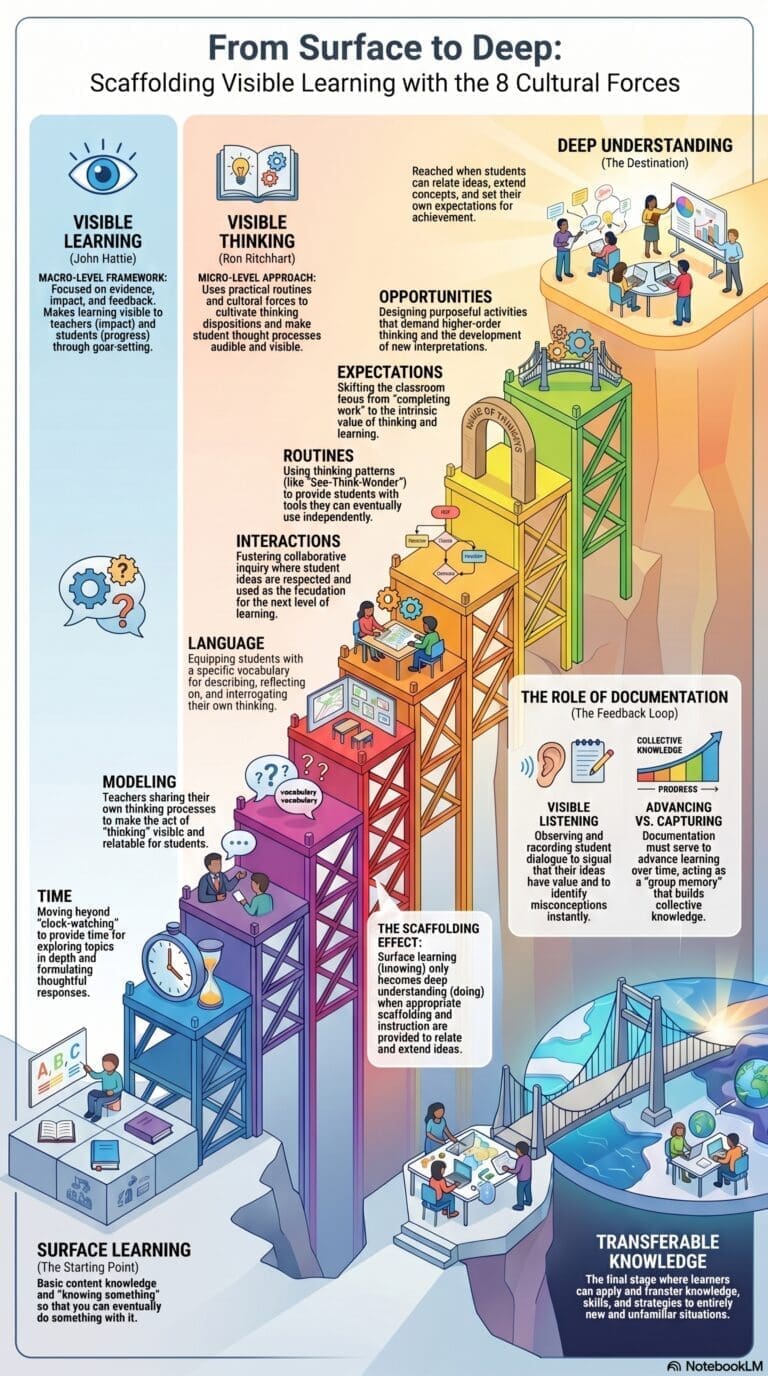
Thinking doesn’t get stronger because we tell students to “go deeper.” It gets stronger when we give it shape. Thinking routines are short moves teachers use to help students slow down, notice details, ask better questions, and explain ideas with evidence.
That’s why teachers keep coming back to them. They’re simple, repeatable, and useful across subjects. Once students know the routine, the class can spend less time guessing what to do and more time doing the hard thinking.
What thinking routines are, and why they matter for critical thinking
A thinking routine is a short, repeatable structure for thinking. It might be three questions. It might be a sequence of prompts. Either way, the goal is the same: help students think on purpose, not by accident.
Project Zero’s Thinking Routine Toolbox puts this idea in clear classroom terms. These routines make student thinking visible. That matters because quick answers can fool us. A student may sound confident and still be guessing.
The routine is short. The thinking isn’t.
How thinking routines guide students step by step
Critical thinking can feel slippery for students. “Analyze this” sounds clear to adults. To a student, it can sound like a fog bank. A routine cuts through that fog.
It breaks a big mental task into smaller moves. First, notice. Then infer. Then question. Then justify. That sequence helps students stay with an idea long enough to examine it.
Without structure, students often jump to the first answer that feels right. With structure, they have to slow down. They look for details. They test a claim. They explain how they know. That’s the heart of critical thinking.
The best part is that routines don’t do the thinking for students. They simply hold the door open. Students still have to observe, connect, challenge, and defend their ideas.
Why teachers use them across subjects and grade levels
Teachers use these routines because they travel well. They work in reading when students interpret a character’s choices. They work in science when students study a phenomenon. They work in social studies when students weigh sources and viewpoints. They even fit math, art, and music.
They also don’t need a complicated setup. A routine can take three minutes or thirty. You can run one in a whole-class discussion, in pairs, on sticky notes, or in a notebook.
That flexibility matters. So does repetition. When students use the same routine across the year, they stop spending energy on directions. The thinking move becomes familiar. Then the real work can begin.
Examples of thinking routines teachers can use right away
You don’t need a giant menu to start. A few well-chosen routines can change the tone of a lesson fast. If you want more school-based models, Two Rivers shares strong examples of classroom critical thinking routines.

See-Think-Wonder for observation and curiosity
This routine is a favorite for a reason. Students first say what they see. Then they share what they think it means. Last, they say what they wonder.
That sequence sounds simple, but it changes the pace of the room. Students can’t jump straight to a conclusion. They have to ground their ideas in what is right in front of them.
Picture a history class studying a photograph from the Great Depression. Students notice worn clothing, empty streets, or facial expressions. Then they infer what those details might suggest about the time period. Finally, they ask questions that can drive research.
Used well, See-Think-Wonder teaches two habits that matter in every subject: close observation and honest curiosity.
Claim-Support-Question for evidence-based thinking
Claim-Support-Question asks students to make an idea, back it up, and test it. The first part is the claim. The second is the support, using evidence or reasoning. The third is a question that pushes the thinking further.
This routine is useful when students tend to confuse opinion with proof. In reading, a student might claim that a narrator is unreliable, then support it with contradictions in the text, then ask what the narrator gains by hiding the truth. In science, a student might claim that a plant grew more under one condition, then point to the data, then ask what variable still needs testing.
That’s what makes the routine strong. It doesn’t stop at “I think.” It asks, “Why do you think that?” and “What still needs checking?”
Circle of Viewpoints for perspective taking
Circle of Viewpoints asks students to step outside their own position. They take on a role, voice, or perspective and think from there.
In social studies, students might respond to a new law as a factory owner, a worker, a parent, or a local official. In literature, they might consider a conflict from the view of two characters and a bystander. In science, they might think about environmental policy from the view of a scientist, farmer, or community member.
This routine is good for more than empathy. It sharpens reasoning. Students start to see that disagreement is not always a sign of confusion. Sometimes people reach different conclusions because they stand in different places and value different evidence.
Connect-Extend-Challenge for deeper reflection
This routine works well after a lesson, text, experiment, or project. Students ask three things: What connects to what I already know? What extends or stretches my thinking? What still challenges me?
That last part matters. Many students are trained to hide confusion. This routine gives them a safe way to name it. A challenge is not failure. It’s information.
After a science investigation, a student might connect the results to a prior unit on ecosystems, extend their thinking about cause and effect, and challenge the reliability of one measurement. After a novel study, a student might connect a theme to another text, extend their thinking about symbolism, and admit that the ending still feels unresolved.
It’s a clean way to build metacognition without turning reflection into fluff.
How these routines support stronger classroom thinking
When teachers use routines often, the payoff shows up in the room. Participation improves. Reasoning gets sharper. Students start owning more of the intellectual work.
That’s not magic. It’s the result of giving students a structure they can trust.
They help students speak and write with more confidence
Many students have ideas before they have language. A routine gives them a place to start. That’s huge for hesitant speakers, multilingual learners, and students who need more processing time.
Instead of asking for an instant whole-class response, a teacher can offer a frame. What do you see? What’s your claim? What still challenges you? Those prompts lower the entry barrier without lowering the level of thinking.
Over time, students begin to internalize the structure. Their talk gets clearer. Their writing gets stronger because they already practiced explaining a thought in parts.
This also connects to student ownership. When learners know how to think through a problem, they rely less on teacher rescue. That shift shows up clearly in how student agency supports visible thinking.
They make discussion more focused and evidence based
Classroom talk can drift fast. One student shares an opinion. Another disagrees. A third changes the subject. Five minutes later, the room has energy but no direction.
Thinking routines help fix that. They keep discussion tied to a clear move, such as noticing, supporting, questioning, or considering another viewpoint.
As a result, students listen more closely. They have a reason to track what others say. They also get better at building on an idea instead of repeating it. “I agree” turns into “I agree because the text shows…” or “I want to challenge that because the data suggests…”
That’s the shift teachers want. Not more talking, just better talking.
Easy ways to use thinking routines in the classroom
You don’t need to rebuild your lesson plan to make these work. Start small. Pick one routine and use it at a point where students already need to pause and think.
That could be the beginning, middle, or end of a lesson.
Use them at the start, middle, or end of a lesson
At the start, routines can activate prior knowledge and spark curiosity. See-Think-Wonder works well with an image, quote, graph, or object. Students enter the topic by noticing first, not guessing first.
In the middle, a routine can check understanding. Claim-Support-Question is strong here because it shows whether students can support an idea with evidence while learning is still in progress.
At the end, reflection routines help students consolidate thinking. Connect-Extend-Challenge gives you quick insight into what stuck, what stretched thinking, and what still needs attention.
That one lesson cycle matters. Start with curiosity. Pause for reasoning. End with reflection. Suddenly the learning has a spine.
Model the routine first, then let students practice it often
Students get better at routines when the teacher models them out loud. Show the thinking, not just the directions. If you’re using See-Think-Wonder, narrate your own noticing before asking students to try it.
Then move into guided practice. Use a familiar text or image. Keep the first round short. Let students hear sample responses and compare what counts as strong evidence or a thoughtful question.
After that, repeat. Don’t treat the routine like a one-time activity you checked off in September. Repeated use is what turns it into a habit. If you want help matching purpose to routine, this routine selection guide is a useful planning tool.
Consistency matters more than variety at first. One routine used well beats six routines students barely know.
Conclusion
Thinking routines are small tools, but they can change the quality of classroom thinking in a big way. They give students a clear path into observation, reasoning, questioning, and reflection.
If you’re deciding where to start, keep it simple. Pick one routine, use it in one lesson, and watch what becomes visible.
That’s the real win. Thinking stops hiding in students’ heads and starts showing up in their words, their writing, and their choices.
Reference
Ritchhart, R. (n.d.). Routines. THINKING PATHWAYS. https://thinkingpathwayz.weebly.com/routines.html
PZ Thinking Routines. PZ Thinking Routines | Project Zero. (n.d.). https://pz.harvard.edu/thinking-routines
Teaching critical thinking routines. Two Rivers Learning Institute. (2021, June 2). https://learn.tworiverspcs.org/our-approach/instructional-practices/teaching-and-assessing-critical-thinking-skills/teaching-critical-thinking-routines/
Lee, M. W. (2026, April 16). Student agency: Building a thinking classroom through new roles. Teacher Clarity. https://educationblogdesk.com/student-agency-building-a-culture-of-thinking-through-changing-roles/
Selecting a thinking routine. (2023). https://pz.harvard.edu/sites/default/files/Selecting%20a%20Thinking%20Routine.pdf