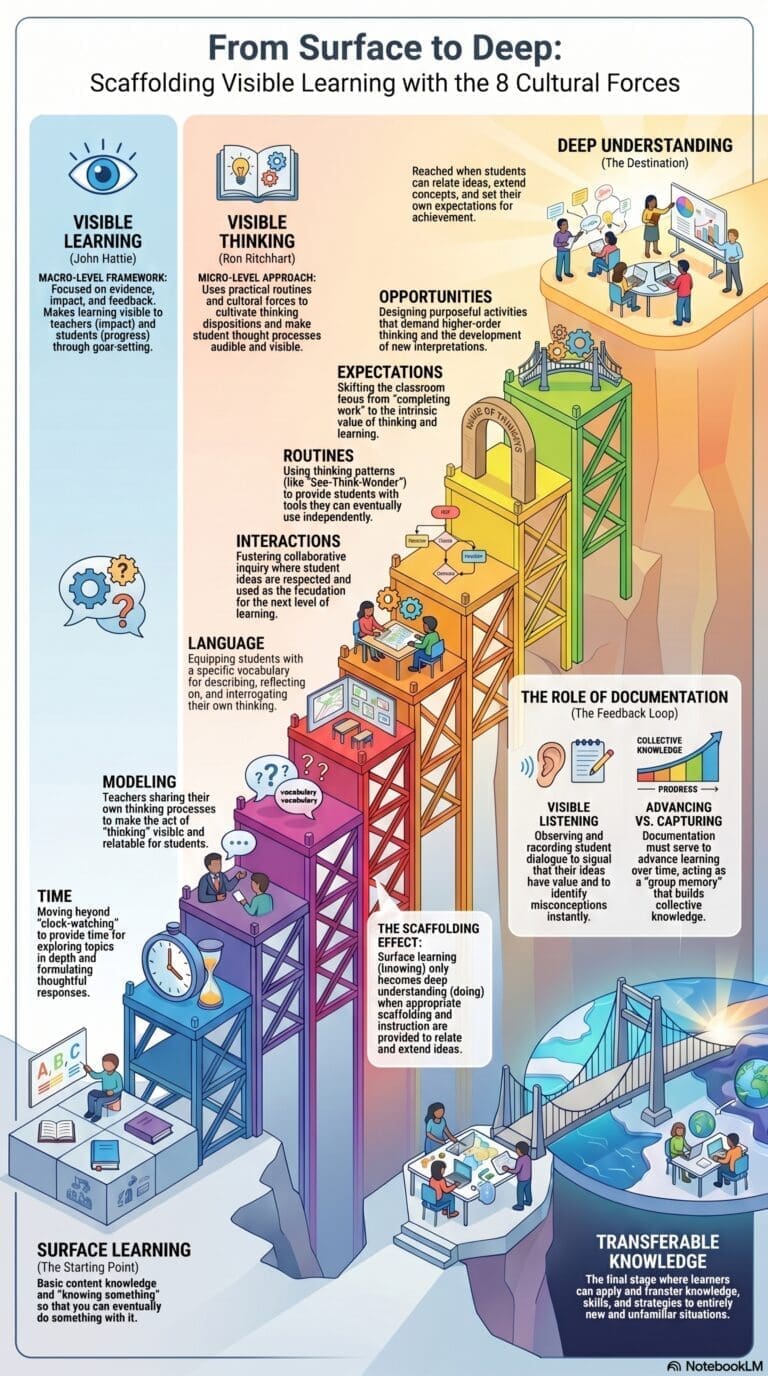
Visible Learning in Action: How to Document and Value Student Thinking

Discover how Learning as a Consequence of Thinking connects to Visible Learning. Practical strategies for teachers to document and value student thinking in the classroom.
Teacher Clarity: Understanding How Learners Learn
Student agency gives students voice and choice in learning through meaningful and relevant activities, driven interests and self-initiation

Discover how Learning as a Consequence of Thinking connects to Visible Learning. Practical strategies for teachers to document and value student thinking in the classroom.

Thinking doesn’t get stronger because we tell students to “go deeper.” It gets stronger when we give it shape. Thinking routines are short moves teachers use to help students slow down, notice details, ask better questions, and explain ideas with…

From Student Agency: Building A Culture of Thinking Through Changing Roles, anchor page, I discussed that a Culture of Thinking means the eight forces that shape classroom life: expectations, language, time, modeling, routines, interactions, opportunities, and environment (Project Zero, 2024).…

Sense of Belonging shapes how students enter a room, read a task, and handle a hard day. When students feel seen, safe, valued, respected, and connected, learning gets easier to access. Attendance improves, behavior often settles, and students take more…
Introduction Self-efficacy is a student’s belief that they can succeed at a task. That belief shapes whether they start, how long they stick with it, and what they do when learning gets hard. For educators, the goal isn’t to choose…
Ms. Rivera collects lab notebooks and sees the same pattern again. The conclusion sections look “finished,” but the reasoning is thin. When she writes feedback, students skim it, then move on. The next lab looks the same. So she tries…
Identity and Agency Defined Identity refers to our comprehensive understanding of our own features, our self- perception in relation to others, our perceived abilities, and our recognition of our weaknesses, as stated by Nancy Frey, Douglas Fisher, and Dominique Smith,…
Collaborative Relationships for Learning Improving Students’ Relationships with Teachers to Provide Essential Supports for Learning In their book, Partnering with Students, authors Mary O’Connell and Kara Vandas provide strategies for better collaborative relationships of learning. Collaborative relationships for learning are…
Why Empower Student Learning So Important 6 Truths came about when I read Spencer and Juliani use the Louis Braille story to focus on giving kids the knowledge and skills to pursue their passions, interests, and future. Louis Braille as…
Practice Mind and Skill Sets Shape Classroom Culture What is a Learner-Centered Classroom Culture? Practice mind and skill sets shape classroom culture by teachers involving students in what it means to belong to the group, how they act as a…
Build Framework for Student Agency What is an Agency? Bill Zima, author of Mindsets and Skillsets for Learning: A Framework for Building Student Agency, defines agency as the perceived ability of the individual, based on his or her capacity, to…
Using Student Choice to Support Motivation Chase Nordengren, author of Step into Student Goal Setting book, writes ‘no matter how your classroom is designed or how much authority you exercise over students, they always retain the most important decision: the…
Voice and Choice Voice and Choice are the two core tenets of Student-Center-Learning, according to Christa Green and Christopher Harrington, authors of the “How Implementing Voice and Choice Can Improve Student Engagement” article. Green and Harrington explore voice and choice…