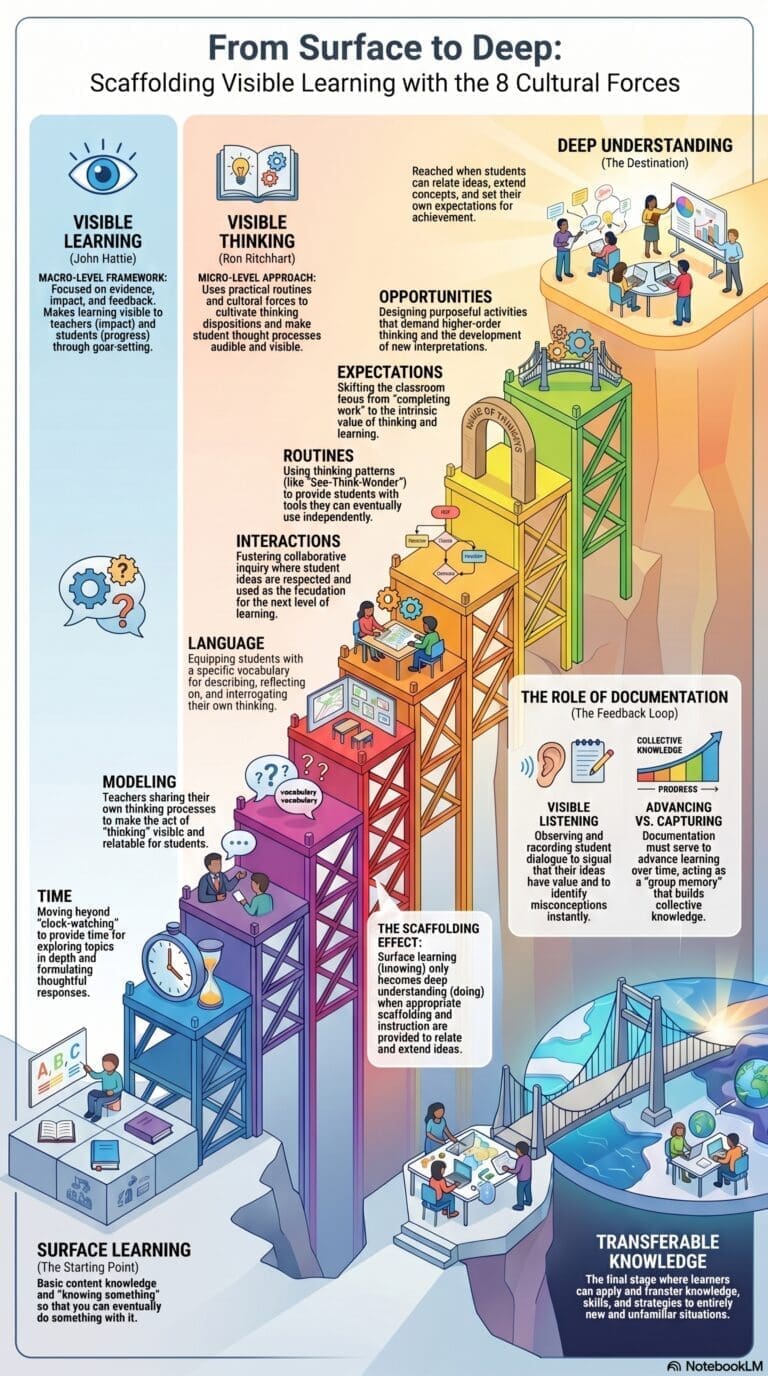
Visible Learning in Action: How to Document and Value Student Thinking

Discover how Learning as a Consequence of Thinking connects to Visible Learning. Practical strategies for teachers to document and value student thinking in the classroom.
Teacher Clarity: Understanding How Learners Learn
Project Based Learning (PBL) is students acquire content knowledge and skills to answer a driving question. based on an authentic problem.

Discover how Learning as a Consequence of Thinking connects to Visible Learning. Practical strategies for teachers to document and value student thinking in the classroom.

Thinking doesn’t get stronger because we tell students to “go deeper.” It gets stronger when we give it shape. Thinking routines are short moves teachers use to help students slow down, notice details, ask better questions, and explain ideas with…

Big project-based learning units can feel like asking students to cook a full feast before they’ve learned how to chop an onion. Teachers feel it too. There’s a lot to manage, a lot to assess, and a lot that can…

Projects can energize a class and still miss the mark. Students may stay busy, make attractive products, and enjoy the process, yet finish with thin understanding and uneven work. That is why PBL with Clarity matters. In simple terms, project-based…

From Student Agency: Building A Culture of Thinking Through Changing Roles, anchor page, I discussed that a Culture of Thinking means the eight forces that shape classroom life: expectations, language, time, modeling, routines, interactions, opportunities, and environment (Project Zero, 2024).…

A driving question is the question that gives a project-based learning unit its job. It tells students what they are trying to figure out, why the work matters, and what ties the lessons together. Without it, a project can feel…

Sense of Belonging shapes how students enter a room, read a task, and handle a hard day. When students feel seen, safe, valued, respected, and connected, learning gets easier to access. Attendance improves, behavior often settles, and students take more…
Introduction Self-efficacy is a student’s belief that they can succeed at a task. That belief shapes whether they start, how long they stick with it, and what they do when learning gets hard. For educators, the goal isn’t to choose…
Ms. Rivera collects lab notebooks and sees the same pattern again. The conclusion sections look “finished,” but the reasoning is thin. When she writes feedback, students skim it, then move on. The next lab looks the same. So she tries…
Introduction What leads students to ask their own questions in class? In Beautiful Questions in the Classroom, Warren Berger describes a two-part approach he calls the Provoke and Release Strategy. This method uses curiosity as the starting point and gives students space…
What is SCRUM? Why I Scrum: Using a Project Management Tool for PBL SCRUM tools support Scrum ceremonies, including planning sprints, keeping track of daily work, refining backlogs, and using data from the past to keep improving. When people work…
Seeking Rigor In PBL What is Rigorous Project Based Learning? Robert Marzano presents a way to design projects that emphasizes the enhancement of students’ options. He uses structures that provide clear pathways to rigor from his book Understanding Rigor in…
Identity and Agency Defined Identity refers to our comprehensive understanding of our own features, our self- perception in relation to others, our perceived abilities, and our recognition of our weaknesses, as stated by Nancy Frey, Douglas Fisher, and Dominique Smith,…
Creating a Culture of Inquiry Culture of Inquiry Six key things educators can do to create a culture, atmosphere, and environment where students are more comfortable asking questions and more inclined to do so are: Foster an Appreciation of Questioning…
What Makes a Good Question? Jim Knight, author of The Beautiful Questions, asks what makes a good question? Answer effective questions are Empowering Authentic Respectful Invitational Empowering Asking good questions empowers the one receiving the inquiry, not the one posing…
Collaborative Relationships for Learning Improving Students’ Relationships with Teachers to Provide Essential Supports for Learning In their book, Partnering with Students, authors Mary O’Connell and Kara Vandas provide strategies for better collaborative relationships of learning. Collaborative relationships for learning are…